Key takeaways
- When you switch music distributors, your streams, playlist placements and release history stay intact as long as ISRC, UPC and metadata are carried over unchanged.
- Your old distributor should only take releases down once they are live on every platform through your new distributor.
- In 2026, labels are paying particular attention to independence, AI labelling, protection against streaming fraud and personal support.
Why are so many labels looking to switch music distributors in 2026?
You can switch music distributors without release outages as long as ISRCs, UPCs and metadata stay exactly the same and your old distributor only takes releases down once the new one is live everywhere. It sounds simple. In practice, though, switches tend to fail on exactly these details.
A clear shift is under way in music distribution:
On 15 September 2026, Universal Music Group filed a lawsuit against DistroKid. The allegations: deceptive trade practices and copyright infringement, including through mass uploads of AI-generated content. Important: these are allegations, not a ruling. DistroKid disputes them. (Music Business Worldwide)
One day earlier, the IFPI launched its Streaming Integrity Initiative. The message to the industry is clear: distributors are expected to check more thoroughly where content comes from, who owns the rights and how it was created. (RouteNote)
Two further developments add to this:
- Platforms are cleaning up. Streaming services are increasingly cracking down on tracks without meaningful streams. Deezer has already deleted millions of such tracks, while Spotify and Amazon Music are tightening their requirements for distributors (Hypebot). Labels often only notice when releases suddenly disappear.
- Majors are buying distribution infrastructure. In February 2026, Universal Music received EU approval to acquire Downtown, which owns the distributors FUGA and CD Baby (Music Business Worldwide). Warner is also expanding its indie distribution arm ADA, integrating Africori, a distributor it fully acquired in 2025 (Music Business Worldwide). For labels that want to stay independent, the distributor’s own independence is becoming a selection criterion.
For many labels, 2026 is therefore the moment to review their distribution strategy. This guide shows when a switch makes sense and how to do it without outages.
When should a label switch music distributors?
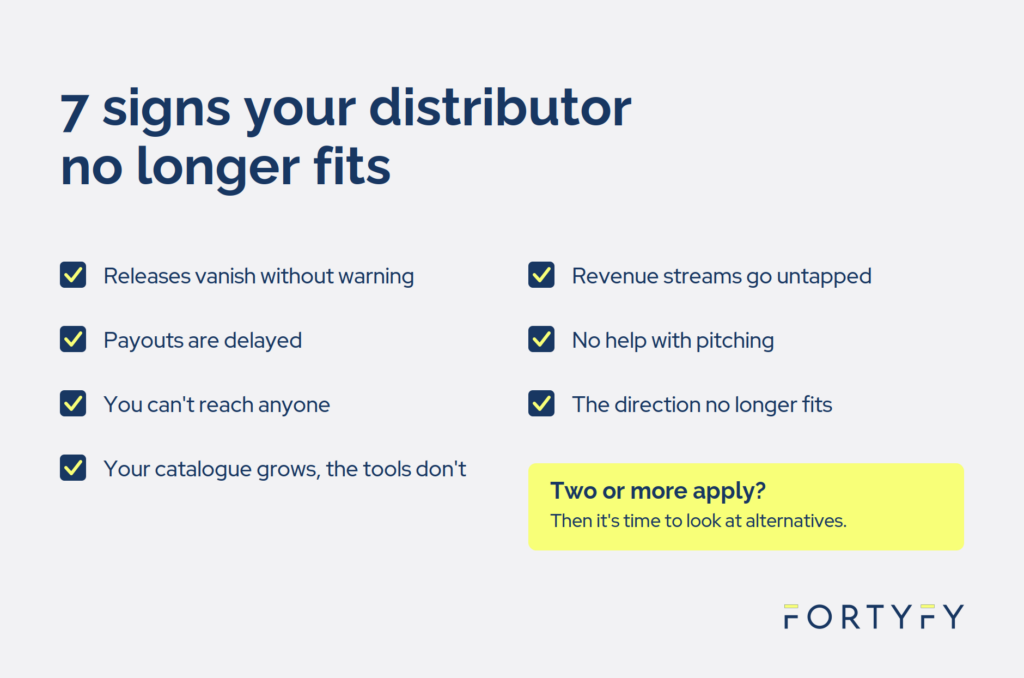
A switch makes sense when your distributor is no longer growing with your label. Take these seven signs seriously:
- Releases disappear without warning. Takedowns with no explanation and no one to contact are a red flag.
- Payouts are delayed or withheld. You should always be able to see which revenue comes in, when and why.
- You can’t reach anyone. A ticket system without real answers isn’t enough when an important release is coming up.
- Your catalogue is growing, but the tools aren’t. Multiple artists, sublabels and hundreds of tracks need proper management, reporting and rights management.
- Revenue streams are going untapped. YouTube Content ID, neighbouring rights or publishing stay unused because your distributor doesn’t cover them.
- There’s no support with pitching and placements. An upload alone doesn’t bring reach.
- The direction no longer fits. If your distributor suddenly belongs to a major, priorities, terms and contacts often change.
Rule of thumb: If two or more of these apply, it’s time to look at alternatives.
What stays intact when you switch distributors, and what can go wrong?
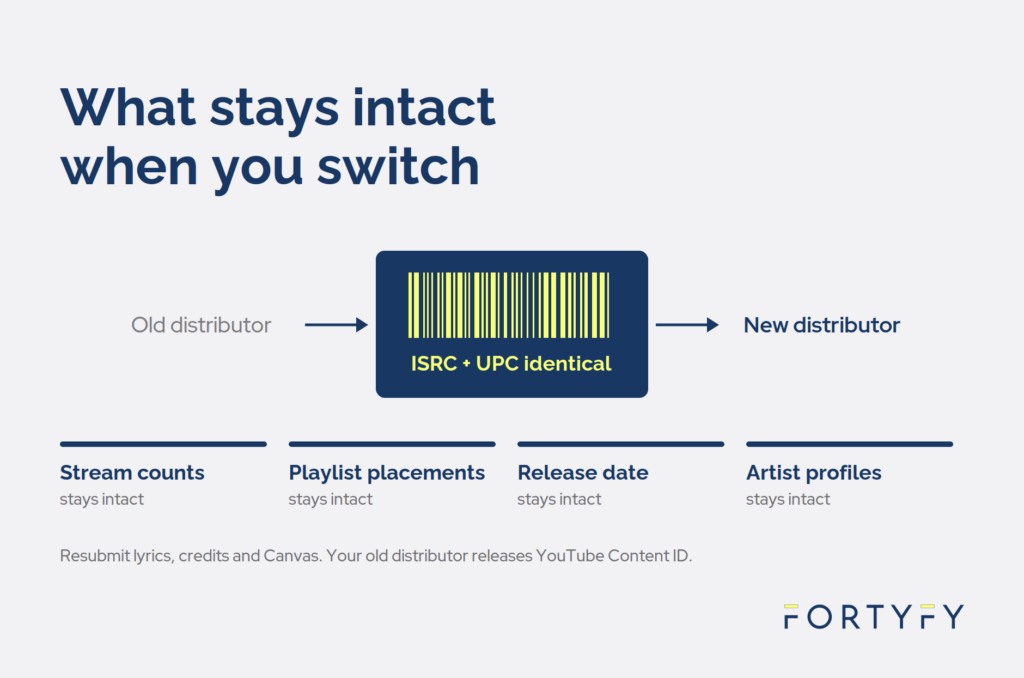
The most important news first: streams, playlist placements and release history are not lost as long as ISRC and UPC stay the same. The ISRC (International Standard Recording Code) identifies a single recording, the UPC (Universal Product Code) a complete release. Spotify, Apple Music and other platforms assign streams via these codes, not via the distributor.
To make sure nothing gets lost when you switch, these are the points that matter:
- Stream counts: stay intact if ISRC and UPC are carried over identically. If not, the count resets to zero.
- Playlist placements: stay intact if the new release is live before the old one goes offline. If not, the track drops out of playlists.
- Release date: stays intact if the original date is carried over. If not, the release appears as “new”.
- Artist profiles: stay intact if existing artist IDs (e.g. Spotify, Apple Music) are handed over and artist names are spelled exactly the same. If not, you end up with duplicate or misassigned profiles.
- YouTube Content ID: stays intact if the old distributor releases its claims. If not, duplicate claims block monetisation.
- Lyrics, credits and Canvas: need to be resubmitted. If not, they will be missing after the switch.
- New ISRCs or UPCs are assigned because the old ones aren’t available.
- The old distributor takes releases down before the new distributor has delivered them.
- Spellings of titles, artists or featured artists differ slightly.
- Outstanding payouts from the old distributor are forgotten. Statements often keep coming in for several months.
How to switch music distributors without release outages: 8-step guide
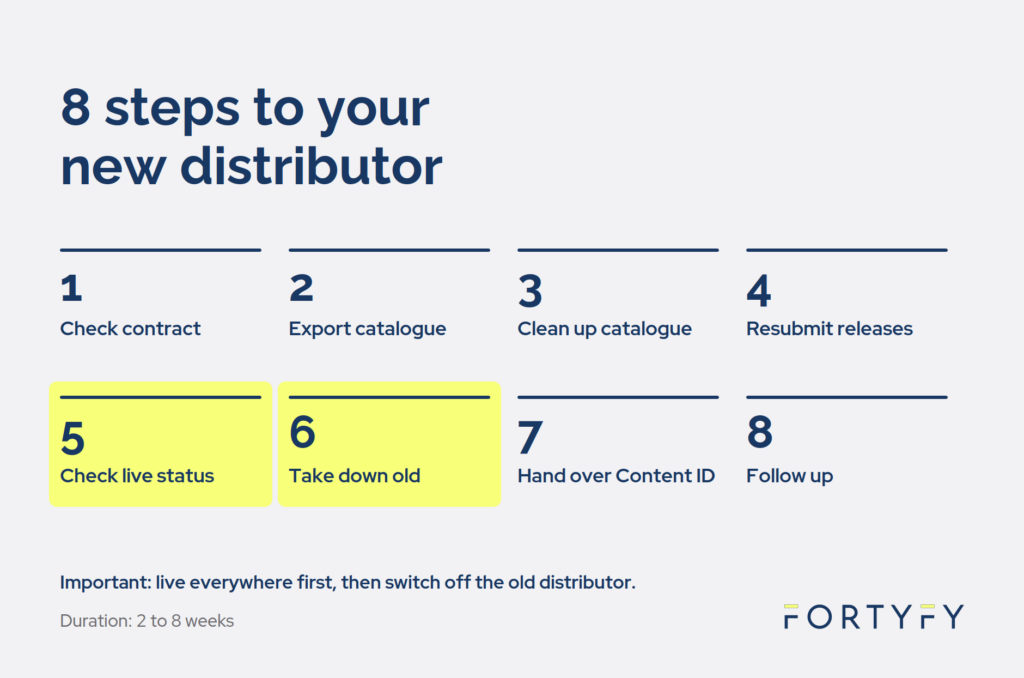
A distributor switch needs careful planning. The order is crucial.
- Check your contract. Clarify notice periods, exclusivity and terms with your old distributor. Only give notice once your plan is in place.
- Export your catalogue. Save all releases with ISRC, UPC, release date, label name, credits and artwork, ideally as a metadata export plus audio files in original quality.
- Clean up your catalogue. This is the best time to deal with legacy issues: correct faulty metadata, label AI involvement correctly, check rights for samples and cover versions.
- Submit to your new distributor. Create releases with identical codes and metadata, carry over the original release date and include the existing artist IDs so releases land in the right profile.
- Check the live status. Only continue once every release is live and correctly matched on all major platforms.
- Request takedown from your old distributor. Staggered and coordinated with your new distributor, never before.
- Hand over YouTube Content ID. The old distributor releases its claims and the new one takes over monetisation.
- Follow up. Monitor stream counts, playlists and artist profiles for two to four weeks. Keep an eye on outstanding payouts from your old distributor.
Tip: Don’t switch in the middle of a release campaign. Plan the move for a quiet period without major releases.
What should labels look for when choosing a new music distributor?
Your new distributor shouldn’t just fit today, it should also meet tomorrow’s requirements. In 2026, that means above all:
- Independence. Who owns the distributor? An independent partner doesn’t pursue major-label interests and doesn’t treat your catalogue as a side product.
- Proper AI labelling. Platforms increasingly require transparency about AI involvement. Your distributor should be able to handle this at track and artwork level.
- Active protection against streaming fraud. Distributors are responsible for checking the origin and rights of content. Those who take this seriously also protect your catalogue from mass takedowns.
- Catalogue care, not just uploads. A good distributor spots problems before a platform removes tracks and contacts you proactively.
- Personal support. Dedicated contacts who know your label are invaluable when problems arise.
- All revenue streams in one place. Distribution, YouTube monetisation, neighbouring rights and publishing in one system save time and get more out of your catalogue.
- A fair model. Check whether you pay fees or whether the distributor only earns when you do.
FAQ: Common questions about switching distributors
- Will I lose my streams if I switch music distributors?
No. As long as ISRC and UPC stay identical, the platforms assign all previous streams to the release delivered by your new distributor.
- Will my tracks stay in playlists after the switch?
Yes, if the release is live through your new distributor before the old one takes it down. A takedown before the new release goes live can cost you playlist placements.
- How long does it take to switch music distributors?
As a rule, you can expect two to eight weeks. The exact timing depends on catalogue size, contract term and the notice period with your old distributor.
- Can I keep the ISRC and UPC from my old distributor?
Yes. ISRCs belong to the recording and UPCs to the release, not to the distributor. Make sure your export includes all codes in full.
- What happens to outstanding payouts from my old distributor?
Platforms report with a delay. Revenue from before the switch therefore often keeps coming in via your old distributor for several months.
- What happens to YouTube Content ID when I switch?
Your old distributor has to release its claims. Only then can your new distributor take over monetisation without duplicate claims.
- Can I move just part of my catalogue to a new distributor?
Yes, as long as your contract doesn't require exclusivity for the entire catalogue. What matters is that each release is delivered by only one distributor per platform.
- Do I need to switch because of the lawsuit against DistroKid?
Not automatically. A court case doesn't directly affect your existing releases. It does make sense, though, to review your distribution strategy and assess how well your distributor fits your growing label.
Conclusion: Switching music distributors can be planned
A distributor switch doesn’t have to be a risk. With identical codes, clean metadata and the right order, your streams, playlists and history stay intact. What matters is a distributor that actively supports you through the move.
Switching to FORTYFY
At FORTYFY, we personally guide labels through the entire switch, from catalogue export to follow-up. As an independent distributor based in Hamburg, we have been part of the industry for more than 20 years.
- No distribution fees: We only earn when you earn.
- Independent: No major behind us, full control over your catalogue.
- Everything in one place: Music distribution, YouTube monetisation, neighbouring rights and publishing.
- AI labelling right in the console: audio at track level, artwork at product level.
- Personal support: dedicated contacts instead of a ticket system.
Your catalogue deserves more than an upload service. Let’s talk about your switch.